The Best Things to Do in Tokyo
20 things to do in Tokyo, from Senso-ji to a day in Nikko, checked against each attraction's own website: prices, timed tickets, lotteries and this season's closures.
On a first visit to Tokyo, do not miss Senso-ji in Asakusa, the city’s oldest temple, ideally early in the morning before the crowds reach the Kaminarimon gate. Give a second half-day to the forest of Meiji Jingu and the design streets of Omotesando, then watch the city light up from the open-air rooftop of Shibuya Sky. Walk the Imperial Palace East Gardens, eat your way through the Tsukiji Outer Market, and save a day for Nikko, Kamakura or Hakone.
Several Tokyo sights sell out or need planning. The Ghibli Museum sells only advance, date-and-time tickets, released on the 10th of each month for the month after. teamLab Borderless, teamLab Planets and Shibuya Sky sell timed tickets, the Imperial Palace grounds tour takes applications from the first day of the previous month, and the tuna auction deck at Toyosu Market is allocated by monthly lottery. Every price and opening time below comes from the attraction’s or operator’s own website, checked on 25 October 2026. For where to base yourself, and the accommodation tax change that applies from 1 April 2027, see our guide to where to stay in Tokyo.
At a glance
Adult prices from each official site, as of October 2026. “Time needed” is our own estimate for a typical visit. Where a site uses dynamic pricing, the figure is the price it lists.
| Thing to do | Neighbourhood | Time needed | Cost (adult) | Book ahead? |
|---|---|---|---|---|
| Senso-ji | Asakusa | 1–1.5 hours | No fee listed | No |
| Tokyo National Museum | Ueno | 2–3 hours | ¥1,000 (collection galleries) | No (online tickets recommended at busy times) |
| Tokyo Skytree | Oshiage, near Asakusa | 1–1.5 hours | From ¥1,800 (Floor 350); from ¥3,000 (both decks) | No (¥500 extra at the on-site counter) |
| Imperial Palace East Gardens | Marunouchi | 1–1.5 hours | Free | No |
| Imperial Palace grounds tour | Marunouchi | About 1 hour | No fee listed | Yes (online, or same-day numbered tickets) |
| Tsukiji Outer Market | Tsukiji, near Ginza | 1–2 hours | Pay per dish | No |
| Meiji Jingu | Harajuku | 1–1.5 hours | Free (museum ¥1,000) | No |
| Shibuya Sky | Shibuya | 1–1.5 hours | ¥2,700 online before 3 pm; ¥3,400 from 3 pm | Yes (timed entry, sold two weeks ahead) |
| Nezu Museum | Minami-Aoyama (Omotesando) | 1.5–2 hours | ¥1,600 online (special exhibition) | Recommended (timed online tickets) |
| Shinjuku Gyoen National Garden | Shinjuku | 1.5–2 hours | ¥500 | No |
| Tokyo Metropolitan Government Building observatories | Nishi-Shinjuku | 45 minutes | Free | No |
| Mori Art Museum and Tokyo City View | Roppongi | 2–3 hours | ¥4,500 online combo; ¥2,200 deck only | Recommended (timed slots) |
| teamLab Borderless | Azabudai Hills | 2–3 hours | ¥3,400 (dynamic pricing) | Yes (date and time tickets) |
| Tokyo Tower | Shibakoen | 1 hour | ¥1,500 (Main Deck) | No |
| Toyosu Market | Toyosu | 1.5–2 hours | Free to visit | Lottery for the tuna auction deck |
| teamLab Planets | Toyosu | 1.5–2 hours | ¥3,800 (dynamic pricing) | Yes (time-specified tickets) |
| Ghibli Museum | Mitaka (western Tokyo) | Half a day with travel | ¥1,000 | Yes (advance only; no tickets at the museum) |
| Nikko: Nikko Toshogu | Nikko (day trip) | A full day | ¥1,600 | No |
| Kamakura: Great Buddha at Kotoku-in | Kamakura (day trip) | Half a day to a day | ¥300 (+¥50 to go inside the statue) | No |
| Hakone | Hakone (day trip) | A full day | Hakone Freepass from Shinjuku ¥7,100 (2 days) | No |
Asakusa and Ueno
Asakusa, on the Sumida River in the north-east, grew up around Senso-ji and keeps an old-Tokyo character. Ueno, a short ride west, is built around Ueno Park and its museums. Tokyo Skytree rises across the river in Oshiage.
Senso-ji (Asakusa Kannon)
The temple calls itself the oldest in Tokyo. Its founding story dates to 628, when two fishermen pulled a statue of Kannon, the Bodhisattva of compassion, from the Sumida River; the statue has never been shown in public since 645. Enter through the Kaminari-mon, the main gate, rebuilt in 1960 with a donation from Konosuke Matsushita, founder of today’s Panasonic, and walk up Nakamise, one of the oldest shopping streets in Japan, past the Hozo-mon gate to the Main Hall and the Five-Storied Pagoda. The temple says it draws 30 million visitors a year, so come early.
Read next · GuideWhere to Stay in Paris18 min →Practical: The Main Hall is open 6 am to 5 pm (from 6:30 am between October and March); the temple lists no admission fee. The Main Hall, pagoda, Hozo-mon and Kaminari-mon are lit from sunset to about 11 pm every day. Year-end Hagoita (battledore) market 17 to 19 December. Five minutes’ walk from Asakusa Station on the Ginza line, Toei Asakusa line, Tobu line or Tsukuba Express. 2-3-1 Asakusa.

Tokyo National Museum
The national museum’s collection is spread across several buildings in Ueno Park: the Japanese Gallery (Honkan), the Asian Gallery (Toyokan), the Heiseikan and the Gallery of Horyuji Treasures. Displays rotate often, so there is something new each week. This autumn the special exhibitions are Hiroshige: New Perspectives on Edo Japan (to 20 December 2026) and Daitokuji: A Zen Temple Beyond Compare, for the 700th anniversary of the Kyoto temple; a Final Fantasy 40th-anniversary exhibition runs from 8 January to 4 April 2027.
Practical: 9:30 am to 5 pm, and to 8 pm on Fridays and Saturdays (last admission 30 minutes before closing). Closed Mondays (Tuesday when Monday is a holiday) and from 26 to 31 December 2026; open from noon on 1 January 2027. Collection galleries ¥1,000, university students ¥500, free for under-18s and over-70s; free for everyone on 3 November. Special exhibitions are ticketed separately and include the collection galleries that day. Security screening is in place at the Main Gate and suitcases are not allowed in. Several galleries close in rotation for maintenance through April 2027. Ten minutes’ walk from JR Ueno or Uguisudani stations.

Tokyo Skytree
The tower has two observation levels: the Tembo Deck on Floor 350 and the Tembo Galleria on Floor 450. On a clear day the views run across the whole city. GO TOKYO notes that the tower is 634 metres tall.
Practical: The official calendar shows 10 am to 10 pm on weekdays and 9 am to 10 pm at weekends in October 2026; check the date you want. Tembo Deck tickets from ¥1,800 for adults (15 and over); combo tickets for both decks from ¥3,000. Buying at the 4th-floor counter or vending machines adds ¥500 per ticket, so book online. Oshiage and Tokyo Skytree stations are a minute’s walk away.
Marunouchi, the Imperial Palace and Ginza
The Imperial Palace sits behind its moats and stone walls west of Tokyo Station, on the site of Edo Castle. Ginza is a short walk south, and the Tsukiji Outer Market lies just beyond it.

Imperial Palace East Gardens
The eastern part of the palace grounds is open to walk freely. The Imperial Household Agency’s map takes in the stone base of the Edo Castle keep (Tenshudai), the Ninomaru garden, the Suwa no Chaya teahouse, three old guardhouses and the Fujimi-yagura keep. The Museum of the Imperial Collections, Sannomaru Shozokan, is inside the gardens. A free audio-guide app is available.
Practical: Free. Closed Mondays and Fridays (open on national holidays, except 23 February), and from 28 December to 3 January. Hours change by season: 9 am to 4:30 pm in October (entry to 4 pm), 9 am to 4 pm from November to February (entry to 3:30 pm), and to 5 pm or 6 pm from March to September. Enter by the Ote-mon, Hirakawa-mon or Kitahanebashi-mon gates. Bags are inspected, so carry as little as you can.

Imperial Palace grounds tour
The Imperial Household Agency runs guided walks inside the palace grounds proper, which are otherwise closed. The route covers about 2.2 kilometres and passes the Fujimi-yagura keep, the Imperial Household Agency building, the Kyuden Totei Plaza in front of the palace and the Seimon-tetsubashi bridge (Nijubashi).
Practical: Morning and afternoon tours, up to 200 people each. No tours on Sundays, Mondays, national holidays (unless on a Saturday), afternoons from 1 July to 30 September, or 28 December to 4 January. Apply online from 5 am (Japan time) on the 1st of the month before your visit until four days before; same-day numbered tickets are handed out at the Kikyo-mon Gate. Bring photo ID such as a passport, and your permit number. The agency’s pages list no fee. Meet at Kikyo-mon, about 10 minutes’ walk from Nijubashi-mae (Chiyoda line) or Otemachi (Mita line).

Tsukiji Outer Market
The wholesale fish market moved to Toyosu, but the shops and restaurants around it stayed. The market association calls the result Japan’s “food town”: fishmongers, knife and kitchenware shops, dried-food stalls and sushi counters on narrow streets, some in buildings more than 80 years old. Several wholesalers now sell smaller portions to visitors, down to a bite of tamagoyaki.
Practical: Professional buyers have priority from 6 to 9 am; public hours are 9 am to 2 pm, with flexible hours after that. The market follows the Tokyo Central Wholesale Market calendar, and each shop sets its own days, so check the calendar before a Sunday or holiday visit. Eat at the stall or in its eating space, not while walking; do not touch the food or bargain; ask before taking photos. Store large bags in lockers.
Shibuya, Harajuku and Omotesando
Meiji Jingu’s forest sits beside Harajuku Station. Omotesando runs south-east from it through Aoyama’s design shops to the Nezu Museum, and Shibuya is one stop south.

Meiji Jingu
Established in 1920 to honour Emperor Meiji and Empress Shoken, the shrine stands in a 70-hectare forest in the middle of the city. Walk under the large torii gates, past the sake barrels on the south approach, to the Main Sanctuary, where you may see a wedding procession. The Meiji Jingu Museum, designed by Kengo Kuma and opened in 2019, shows objects used by the Emperor and Empress.
Practical: Open daily, free, from sunrise to sunset: 5:40 am to 4:40 pm in October, 6:10 am to 4:10 pm in November, and 6:40 am to 4 pm in December. Allow 10 minutes’ walk from the entrance to the main buildings. Museum 10 am to 4:30 pm (last admission 4 pm), closed Thursdays, adult ¥1,000. Harajuku Station is one minute from the entrance, according to GO TOKYO.
Shibuya Sky
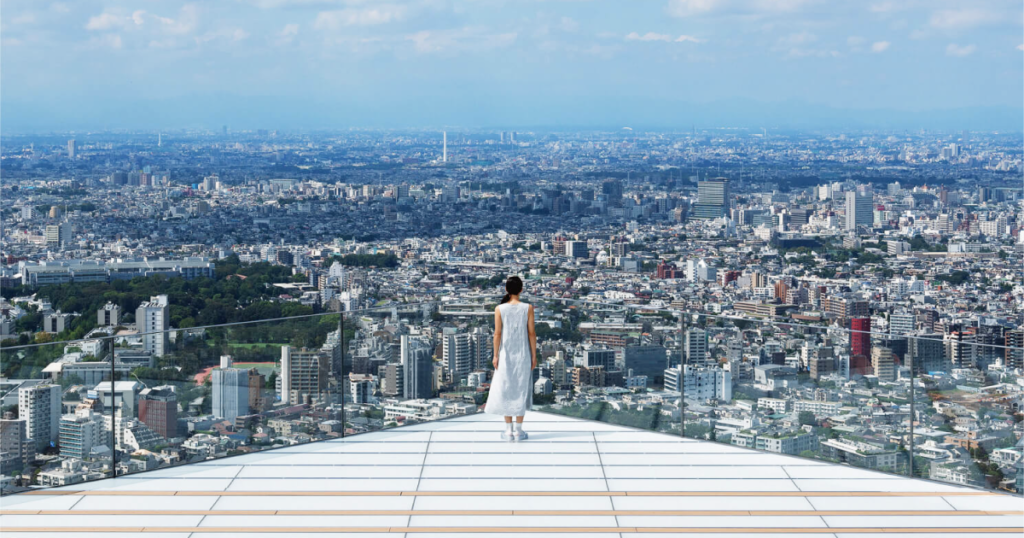
The observation deck at the top of Shibuya Scramble Square includes an open-air rooftop 229 metres above Shibuya, with views across the city. Time it for sunset and stay as the lights come on.
Practical: Open 10 am to 10:30 pm (last entry 9:20 pm). Adult (12 and over) tickets online are ¥2,700 for entry before 3 pm and ¥3,400 from 3 pm; at the counter they are ¥3,000 and ¥3,700, and if online sells out, so does the counter. Children’s tickets (¥1,200) are sold only at the counter on the day. Tickets go on sale two weeks ahead and are timed; late arrivals may be refused. Bags, hats, tripods and selfie sticks are not allowed on the rooftop (lockers are on the 46th floor), and the rooftop closes in strong wind, rain or lightning. The entrance is on the 14th floor.
Nezu Museum
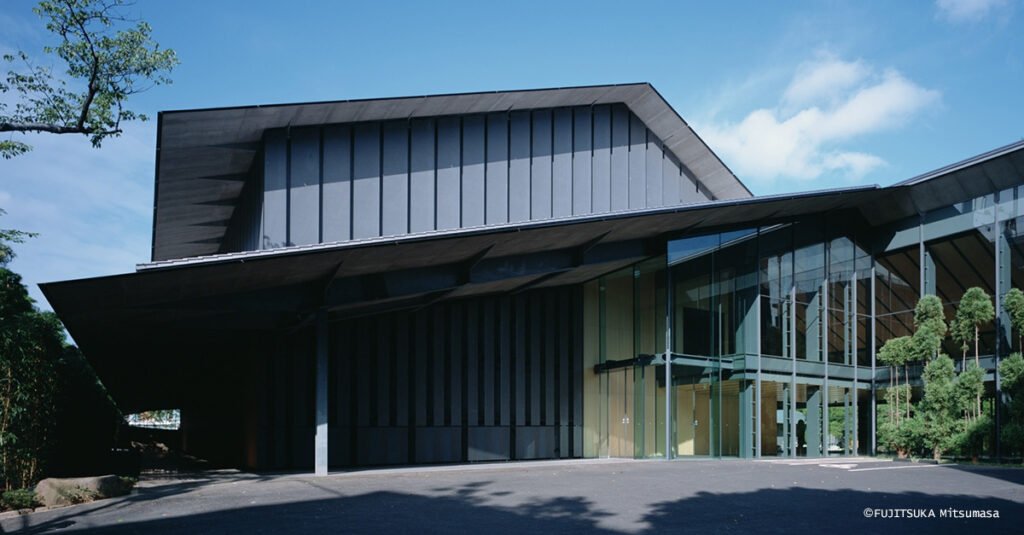
A private collection of Japanese and East Asian art, with National Treasures such as the Irises screens and the Nachi Waterfall painting, shown in rotation. Behind the museum is a garden of hills and hollows bought by Nezu Kaichiro I in 1906, with stone lanterns and teahouses, restored after wartime bombing. To 23 November 2026 the special exhibition is Bugaku Costumes: The Enduring Beauty of Textiles.
Practical: 10 am to 5 pm (entry to 4:30 pm); closed Mondays (Tuesday after a Monday holiday) and between exhibitions. Timed online tickets for the current exhibition cost ¥1,600 (¥1,800 at the door); collection exhibitions ¥1,400 online. The garden, shop and NEZUCAFÉ are open only to museum ticket holders. Eight minutes’ walk from Exit A5 of Omotesando Station (Ginza, Hanzomon and Chiyoda lines).
Shinjuku
Shinjuku has two sides: the office towers of Nishi-Shinjuku to the west and shopping, restaurants and nightlife to the east. The national garden lies to its south-east.
Shinjuku Gyoen National Garden
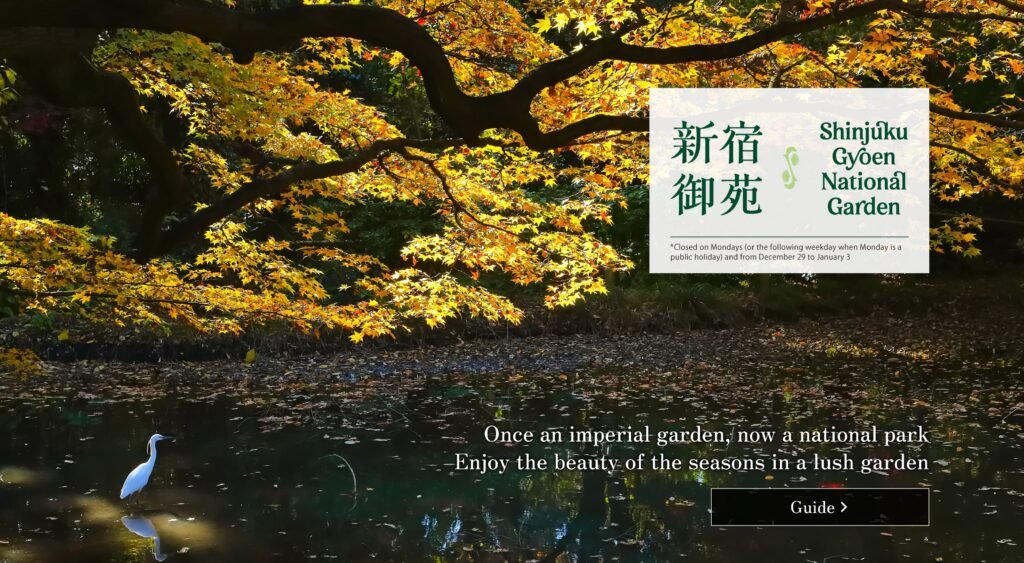
A former imperial garden, now run by the Ministry of the Environment, covering 58.3 hectares across Shinjuku and Shibuya wards. It combines a formal French-style garden with a sycamore avenue, an English-style landscape garden of lawns and tall tulip trees, and a traditional Japanese garden, with about 900 cherry trees of some 70 varieties. It opened to the public as a national garden in 1949. From 1 to 15 November it holds its chrysanthemum exhibition.
Practical: 9 am to 4:30 pm from 1 October to 14 March (last entry 4 pm), and to 6 pm or 7 pm in spring and summer. Closed Mondays (or the next weekday after a Monday holiday) and 29 December to 3 January, but open daily for the chrysanthemum exhibition (1 to 15 November) and cherry blossom season (25 March to 24 April), when entry on busy days may need advance reservation. Adults ¥500, students 16 and over and seniors ¥250, 15 and under free; IC transport cards work at the gates, and e-tickets are sold in advance. Five minutes from Shinjuku-gyoemmae Station or JR Sendagaya Station.
Tokyo Metropolitan Government Building observatories
Two free observation rooms, north and south, sit 202 metres up in Main Building No. 1 of the city hall. Take the observatory elevator from the 1st floor. It is a good alternative to a paid deck, especially at night.
Practical: Free. GO TOKYO lists 9:30 am to 10 pm (last entry 9:30 pm), with the south observatory closed on the first and third Tuesdays and the north on the second and fourth Mondays; the two rooms keep different hours, and either may close at short notice in bad weather. Check the Tokyo Metropolitan Government’s observatory calendar before you go.
Roppongi, Azabudai and Toranomon
The hills south-west of the palace hold Tokyo’s newest towers and much of its contemporary art, from Roppongi Hills to Azabudai Hills, with Tokyo Tower between them.
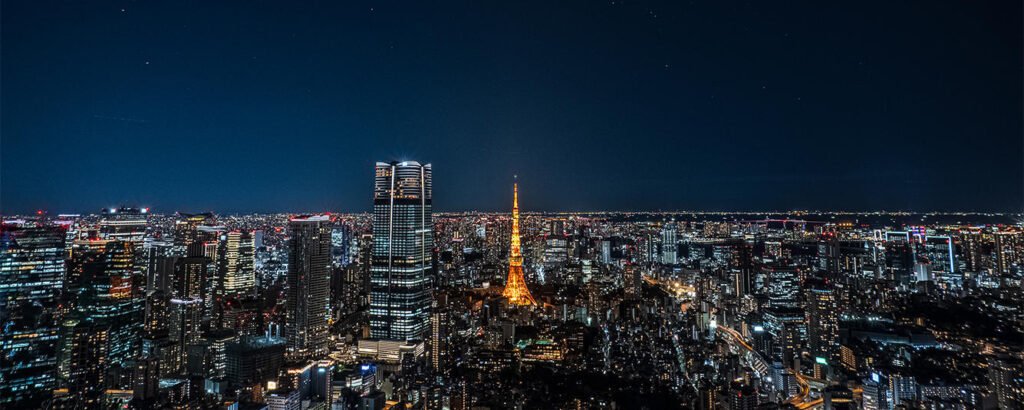
Mori Art Museum and Tokyo City View
The Mori Art Museum occupies the 53rd floor of Roppongi Hills Mori Tower, with the Tokyo City View observation deck on the 52nd. The museum is closed until 30 October 2026 and reopens on 31 October with Mariko Mori: All That Shines (to 28 March 2027), a survey of the artist known since the mid-1990s for her “Cyborg” photographs and later large interactive installations. The museum will then close for renovation from September 2027 to April 2028.
Practical: Museum 10 am to 10 pm (to 5 pm on Tuesdays), last admission 30 minutes before closing. Adult tickets are ¥2,600 online and ¥2,800 on site on weekdays, ¥2,800 and ¥3,000 at weekends. Tokyo City View is open 10 am to 10 pm (last admission 9:30 pm); adult tickets ¥2,200 online, ¥2,400 on site. It is closed on 27 October and 10 to 12 November 2026, and access to the Mt. Fuji side is restricted from 28 to 30 October and 4 to 9 November, when tickets are cheaper. A combo ticket for the exhibition and deck costs ¥4,500 online (¥4,900 on site) from 31 October to 14 February 2027, with some exclusions. Tickets are sold at the 3rd-floor counter.

teamLab Borderless
teamLab describes Borderless as a world of art without boundaries and a “museum without a map”: there is no set route, and no floor plans are handed out, so visitors find the works by wandering. EN TEA HOUSE serves tea inside.
Practical: 8:30 am to 9 pm, to 10 pm on listed dates (in November: 2, 5, 6, 9, 12 and 13); last entry an hour before closing. Closed 24 November and 8 December 2026. Adult (18 and over) Entrance Pass ¥3,400, ages 13 to 17 ¥2,800, ages 4 to 12 ¥1,500, under 4 free; adult prices are dynamic, so check your date. Tickets are for a date and time and may sell out; a Flexible Pass (¥12,000) allows any entry time. No re-entry. Azabudai Hills Garden Plaza B, B1; two minutes from Exit 5 of Kamiyacho Station (Hibiya line).

Tokyo Tower
The 333-metre tower, built in 1958 according to GO TOKYO, is still a Tokyo landmark. The Main Deck is at 150 metres; the Top Deck Tour adds a guided visit to 250 metres. An open-air staircase of about 600 steps climbs to the Main Deck on days it operates.
Practical: Main Deck 9 am to 11 pm (last admission 10:30 pm), adult ¥1,500. Top Deck Tour 9 am to 10:45 pm (last tour 10:15 pm), adult ¥3,300 online or ¥3,500 at the counter. Five minutes’ walk from Akabanebashi Station (Oedo line).
Toyosu and the waterfront
Toyosu is reclaimed land on Tokyo Bay, served by the Yurikamome line and the Tokyo Metro Yurakucho line. Pair the fish market in the early morning with teamLab Planets.

Toyosu Market
Tokyo’s central wholesale fish market. Visitors follow a course through the buildings, with a second-floor walkway over the tuna auction, and the market’s restaurants and shops are open to the public. To watch the auction from the observation deck itself, you need to win a place in the monthly lottery.
Practical: Open 5 am to 5 pm; individual shops set their own hours. Closed Sundays, public holidays and other market holidays (see the market calendar). Tuna auction deck tours run from 5:45 to 6:25 am, meeting at 5:30 am; they are free and allocated by online lottery, up to five people per application. Entries for December 2026 tours open at 3 pm on 4 November and close at 11:59 pm on 10 November; results come on 19 November. Bring photo ID such as a passport. If you are not selected, you can still watch from the second-floor walkway. Toyosu 6-6-1, Koto City.

teamLab Planets
A museum you walk through barefoot: in some rooms the water rises to knee height while projected koi swim around your legs and scatter as flowers; other rooms have mirrored floors. teamLab says Planets runs until the end of 2027.
Practical: 8 am to 10 pm (to 8 pm on 31 December), last entry an hour before closing. Closed 5 November and 3 December 2026. Adults (18 and over) ¥3,800, high school and junior high students ¥2,800, ages 4 to 12 ¥1,500; time-specified tickets with dynamic pricing. Wear clothes that roll up above the knee; shorts can be borrowed free. Three minutes from Exit 1A of Shin-Toyosu Station (Yurikamome) or 10 minutes from Exit 7 of Toyosu Station (Yurakucho line).
Western Tokyo
Ghibli Museum, Mitaka
Studio Ghibli’s museum in Mitaka opened to the public in October 2001. Its Saturn Theater screens original short films, and a new special exhibition opens in its Special Exhibit Room each year. The current special exhibition recreates the studio of the picture-book illustrator Yuriko Yamawaki and runs until May 2027 (tentative). There is also a reading room, the Straw Hat Café and the MAMMA AIUTO! shop.
Practical: 10 am to 6 pm. Closed most Tuesdays, from 4 to 18 November 2026, from 27 December 2026 to 2 January 2027, and on other listed dates. Admission by advance ticket only, for a set date and entry time; nothing is sold at the museum. Ages 19 and over ¥1,000, 13 to 18 ¥700, 7 to 12 ¥400, 4 to 6 ¥100. From overseas, buy through Lawson Ticket: sales open at 10 am Japan time on the 10th of each month for the following month. JR Chuo line to Mitaka (about 20 minutes from Shinjuku), then a 15-minute walk or the community bus (¥230).
Day trips

Nikko: Nikko Toshogu
The shrine to Tokugawa Ieyasu, the first Tokugawa shogun, was established in 1617; most of the present buildings were rebuilt in 1636 under the third shogun, Iemitsu. The visit takes in the carved Yomeimon gate, the sleeping-cat carving in the east corridor, the inner shrine and the “crying dragon” ceiling of the Honjido.
Practical: 9 am to 5 pm from April to October and 9 am to 4 pm from November to March; ticket sales close 30 minutes earlier. Adults and high school students ¥1,600; with the treasure house ¥2,400. English audio guide ¥500 a day. Tobu limited expresses run from Asakusa to Tobu-Nikko in about 1 hour 50 minutes; the JR limited express Nikko from Shinjuku takes about two hours.

Kamakura: the Great Buddha at Kotoku-in
The Kamakura Daibutsu, a bronze Amida Buddha about 11.3 metres tall and some 121 tonnes, has sat in the open air since its hall was destroyed by typhoons in the 14th century and an earthquake in 1498. Work on it began in 1252, and it is a National Treasure. Hase-dera temple is five minutes’ walk away.
Practical: 8 am to 5 pm from October to March and to 5:30 pm from April to September. Entry ¥300, children 6 to 12 ¥150, plus ¥50 to go inside the statue (8 am to 4:30 pm). No reservation needed. Eating and drinking in the grounds is restricted. Take the JR Yokosuka line to Kamakura, then the Enoden line three stops to Hase (about seven minutes) and walk seven minutes.

Hakone
The hot-spring district in the mountains south-west of Tokyo is best seen as a loop: the Hakone Tozan Railway and cable car up from Hakone-Yumoto, the Hakone Ropeway over Owakudani, and a sightseeing cruise across Lake Ashi toward Hakone-jinja shrine. Odakyu’s Hakone Freepass covers that loop.
Practical: The Hakone Freepass from Shinjuku costs ¥7,100 for two days or ¥7,500 for three (children ¥1,600 and ¥1,850). It includes one Odakyu return trip to Odawara and unlimited rides on the Tozan Railway, cable car, Ropeway, sightseeing cruise and designated buses, plus discounts at around 70 sights. The Romancecar limited express costs extra. Services can be suspended in bad weather; check the operation page on the day.
Plan your days
Closing days drive the plan. The Tokyo National Museum, Nezu Museum, Shinjuku Gyoen and the Imperial Palace East Gardens close on Mondays, and the East Gardens close on Fridays too. Imperial Palace tours do not run on Sundays or Mondays. Toyosu Market closes on Sundays and holidays, and the Ghibli Museum on most Tuesdays.
One day. Start at Senso-ji soon after the Main Hall opens, then head south to the Tsukiji Outer Market for a late breakfast or lunch before 2 pm. Walk through Marunouchi to the Imperial Palace East Gardens (before 4 pm in winter). Finish with a timed sunset slot at Shibuya Sky.
Two days. Day one, east: Senso-ji early, the Tokyo National Museum in Ueno, and Tokyo Skytree late in the day. Day two, centre and west: the Tsukiji Outer Market, the Imperial Palace East Gardens (or the palace grounds tour if you have a permit), Meiji Jingu in the afternoon, a walk down Omotesando to the Nezu Museum, and Shibuya Sky at dusk.
Three days. Follow the two-day plan, then spend day three in the south: Shinjuku Gyoen in the morning, teamLab Borderless at Azabudai Hills in the afternoon, and Tokyo City View or Tokyo Tower after dark. If you hold a Ghibli Museum ticket, fit Mitaka around it; if you won the Toyosu lottery, pair the 5:30 am auction with teamLab Planets, which opens at 8 am. With more time, take a day trip to Nikko, Kamakura or Hakone.
Getting around
Cards and tickets. Tokyo’s trains, subways and buses all take rechargeable IC cards. Fares as of October 2026:
| Ticket | Price | What it covers |
|---|---|---|
| Tokyo Subway Ticket, 24 hours | ¥1,000 (child ¥500) | All Tokyo Metro and Toei Subway lines; for overseas visitors and some domestic visitors |
| Tokyo Subway Ticket, 48 hours | ¥1,500 (child ¥750) | As above |
| Tokyo Subway Ticket, 72 hours | ¥2,000 (child ¥1,000) | As above; also sold as a QR-code version online |
| Tokyo Metro single ticket | ¥180–¥330 by distance | One journey; ¥178–¥324 with an IC card |
| PASMO card | From ¥1,000, including a ¥500 deposit | Rechargeable; trains, subways, buses and shops; deposit refunded on return |
| Welcome Suica | Prepaid | JR East’s IC card for visitors, valid 28 days from purchase; also available as the Welcome Suica Mobile app |
Sources: Tokyo Metro and JR East, as of October 2026.
Which pass? The Tokyo Subway Ticket covers the subway only. JR lines, including the Yamanote loop and the Chuo line to Mitaka, need an IC card or a JR ticket. When transferring between subway lines through the ticket gates, complete the change within 60 minutes.
Day trips. Tobu trains to Nikko leave from Asakusa, Odakyu trains to Hakone from Shinjuku, and JR Yokosuka line trains for Kamakura. Limited expresses such as the Romancecar need a separate supplement.
When to go
GO TOKYO describes winter as cold, with highs around 10°C, summer as hot and humid with highs in the 30s and a rainy season in June, and spring and autumn as milder, with a chance of a typhoon in September or October. Spring brings cherry blossom (see our cherry blossom forecast); Shinjuku Gyoen opens daily from 25 March to 24 April and may require reservations on busy days. Autumn brings the Shinjuku Gyoen chrysanthemum exhibition (1 to 15 November) and autumn colour in the gardens. Note that hours shorten in winter: from 1 November the East Gardens close at 4 pm, Nikko Toshogu at 4 pm and Meiji Jingu at about 4 pm. Year-end closures run from late December into early January at the museums, the palace and the gardens. For the colder months, see our guide to Japan in winter.
Tips for advisors
- Diary the release dates. Ghibli Museum tickets go on sale at 10 am Japan time on the 10th of the month before; there are no tickets at the door. Imperial Palace tour applications open at 5 am Japan time on the 1st of the month before and close four days ahead. Shibuya Sky sells two weeks out.
- Imperial Palace tours are for individuals. The Imperial Household Agency says commercial sightseeing operators and related parties are not permitted, and changes to names or numbers are not possible after applying. Have clients apply themselves, with passport details for everyone.
- The Toyosu auction deck is a lottery. Entries close about three weeks before each month starts; December 2026 entries run 4 to 10 November. Do not promise the deck; the second-floor walkway needs no application.
- Brief clients on luggage and dress. The Tokyo National Museum does not allow suitcases and screens bags; Shibuya Sky allows no bags or hats on the rooftop; at teamLab Planets visitors walk barefoot in knee-deep water.
- Check closures before you sell a date. The Ghibli Museum is closed 4 to 18 November 2026; Tokyo City View closes 27 October and 10 to 12 November; teamLab Borderless closes 24 November and 8 December; teamLab Planets closes 5 November and 3 December. The Mori Art Museum closes for renovation from September 2027 to April 2028, and teamLab Planets is scheduled to end in 2027.
- Book online to save. Skytree adds ¥500 at the counter, Tokyo Tower’s Top Deck Tour is ¥200 cheaper online, and Shibuya Sky is ¥300 cheaper online.
FAQ
What should I not miss in Tokyo on a first visit?
Senso-ji in Asakusa, Meiji Jingu, the Imperial Palace East Gardens, the Tsukiji Outer Market and a city view from Shibuya Sky or Tokyo Skytree.
How do I get Ghibli Museum tickets?
Only in advance, for a set date and entry time. From overseas, buy through Lawson Ticket, which releases each month’s tickets at 10 am Japan time on the 10th of the month before. Nothing is sold at the museum. Adult tickets cost ¥1,000.
Do I need to book Shibuya Sky?
Yes, ideally. Tickets are timed and go on sale two weeks ahead; adults pay ¥2,700 online before 3 pm and ¥3,400 from 3 pm. If online sells out, the counter is sold out too.
Can I visit the Imperial Palace?
The East Gardens are free and open to walk in, except on Mondays, Fridays and at New Year. The inner grounds are open only on guided tours, booked online from the 1st of the previous month or by same-day numbered ticket at the Kikyo-mon Gate.
Can I see the tuna auction at Toyosu Market?
Anyone can watch from the second-floor visitor walkway. Places on the observation deck are free but allocated by monthly online lottery, with tours from 5:45 to 6:25 am. The market is closed on Sundays and holidays.
Is the Tokyo Subway Ticket worth it?
It costs ¥1,000 for 24 hours, ¥1,500 for 48 hours or ¥2,000 for 72 hours and covers all Tokyo Metro and Toei Subway lines, where single fares start at ¥180. It does not cover JR lines.
Sources
- Senso-ji: English guide; guide and Main Hall hours (Japanese); illumination (Japanese)
- Tokyo National Museum: getting here, admission and hours; exhibitions and news
- Tokyo Skytree: tickets and prices; opening hours
- Imperial Household Agency: East Gardens of the Imperial Palace
- Imperial Household Agency: Imperial Palace visit guidelines; FAQ
- Tsukiji Outer Market; calendar and business hours; how to tour Tsukiji
- Meiji Jingu: how to visit; about; Meiji Jingu Museum; sanctuary
- Shibuya Sky: tickets (Japanese); hours; access
- Nezu Museum: facility guide; current exhibition; garden
- Shinjuku Gyoen: admission; overview; access
- Tokyo Metropolitan Government: observatories
- Mori Art Museum; Mariko Mori: All That Shines; Roppongi Hills museum and observatory: visit us
- teamLab Borderless
- Tokyo Tower: fees and business hours
- Tokyo Metropolitan Government: Toyosu Market; tuna auction tour application (PDF)
- teamLab Planets
- Ghibli Museum, Mitaka: tickets and calendar; hours and directions; special exhibitions
- Nikko Toshogu: hours and fees (Japanese); history (Japanese); access (Japanese)
- Kotoku-in: visiting; the Great Buddha
- Odakyu Hakone: Hakone Freepass
- Tokyo Metro: Tokyo Subway Ticket; regular tickets; PASMO
- JR East: Welcome Suica
- GO TOKYO: Meiji Jingu; Tokyo Skytree; Tokyo Tower; Tokyo Metropolitan Government No. 1 Building; best times to visit
Where to stay near Tokyo Station, Tokyo
Map by Stay22. If you book through it we may earn a commission, at no cost to you. It never decides what we write.

Andrew Lovesey is Editor-in-Chief of Not An Atlas, and always on the hunt for the next big thing: where to go, where to stay and what's worth the photo. His first trip was to the family cottage in Prince Edward Island, all rolling hills, red sand cliffs and jellyfish drifting in the North Atlantic. He'll sit anywhere but the middle seat (no armrest wars), never flies without the adapter that lets his AirPods play the in-flight movie, and has eaten at a McDonald's in every country he's visited. Iceland gets a pass because it doesn't have one. He once learned to bead earrings from Aleqa Hammond, Greenland's first female premier, on a ship in the Northwest Passage, and will tell anyone who'll listen that Cincinnati is wildly underrated. Friends say charming, driven and loyal. His mum says persuasive. He is also Editor-in-Chief of prompt/power and The Remote. Next stop: Greece.